
Which Angle Grinder Should Tradespeople Buy in 2026?
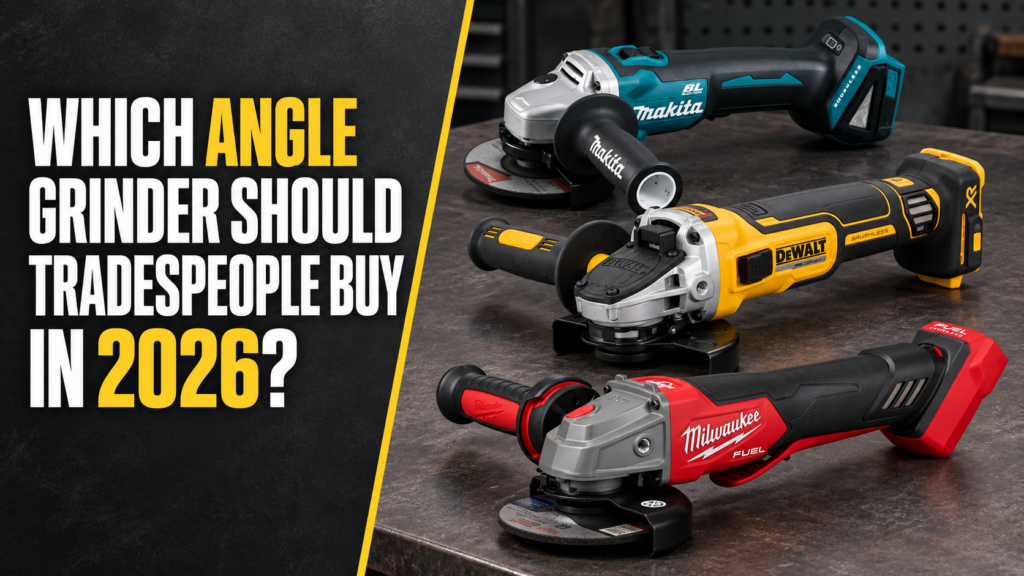
Angle grinders are used across construction, fabrication, plumbing, engineering and metalworking. They can cut steel, remove welds, prepare surfaces and tackle masonry, depending on the disc fitted.
Choosing one should involve more than checking the motor speed or buying the same brand as the rest of your kit.
Disc diameter, switch design, braking, kickback protection, variable speed and battery compatibility can all affect how practical a grinder is on site. The reference article you supplied focuses heavily on these factors when comparing professional cordless grinders.
Below are several strong cordless options for different types of trade work.
Start by Choosing the Right Disc Size
Before comparing brands, decide which disc size actually suits your work.
For most everyday trade applications, 115mm and 125mm grinders provide a good combination of cutting ability and manoeuvrability.
They are commonly used for jobs such as:
- Cutting pipe and smaller steel sections
- Grinding welds
- Surface preparation
- Cutting tiles
- Masonry work
- Working in confined areas
A 230mm grinder is a different type of machine.
Its larger disc provides considerably more cutting depth, making it better suited to structural steel, concrete, masonry and heavier cutting jobs. The trade-off is extra weight and a larger body that can be harder to control in restricted spaces.
For general trade work, a 125mm grinder is often the most versatile place to start.
Pay Attention to the Switch
Switch design is particularly important on an angle grinder.
A paddle switch requires you to maintain pressure while operating the machine. If you release your grip, the grinder stops receiving power.
A conventional locking slide switch can remain running until you manually switch it off.
Some tradespeople prefer a slide switch for longer grinding sessions, while others favour the additional control offered by a paddle arrangement.
Whichever design you choose, make sure you are comfortable operating it before using the grinder under load.
Look for Braking and Kickback Protection
Modern cordless grinders can include several electronic safety systems.
An electronic brake reduces the amount of time the disc continues spinning after the trigger or switch is released.
Kickback protection or an electronic clutch can respond when the disc suddenly binds or stalls.
Anti-restart systems can also stop a grinder from unexpectedly starting after power is restored or a battery is replaced.
These features are worth considering if the grinder will see frequent professional use.
Milwaukee M18FSAGV115XPDB-0 115mm FUEL Grinder
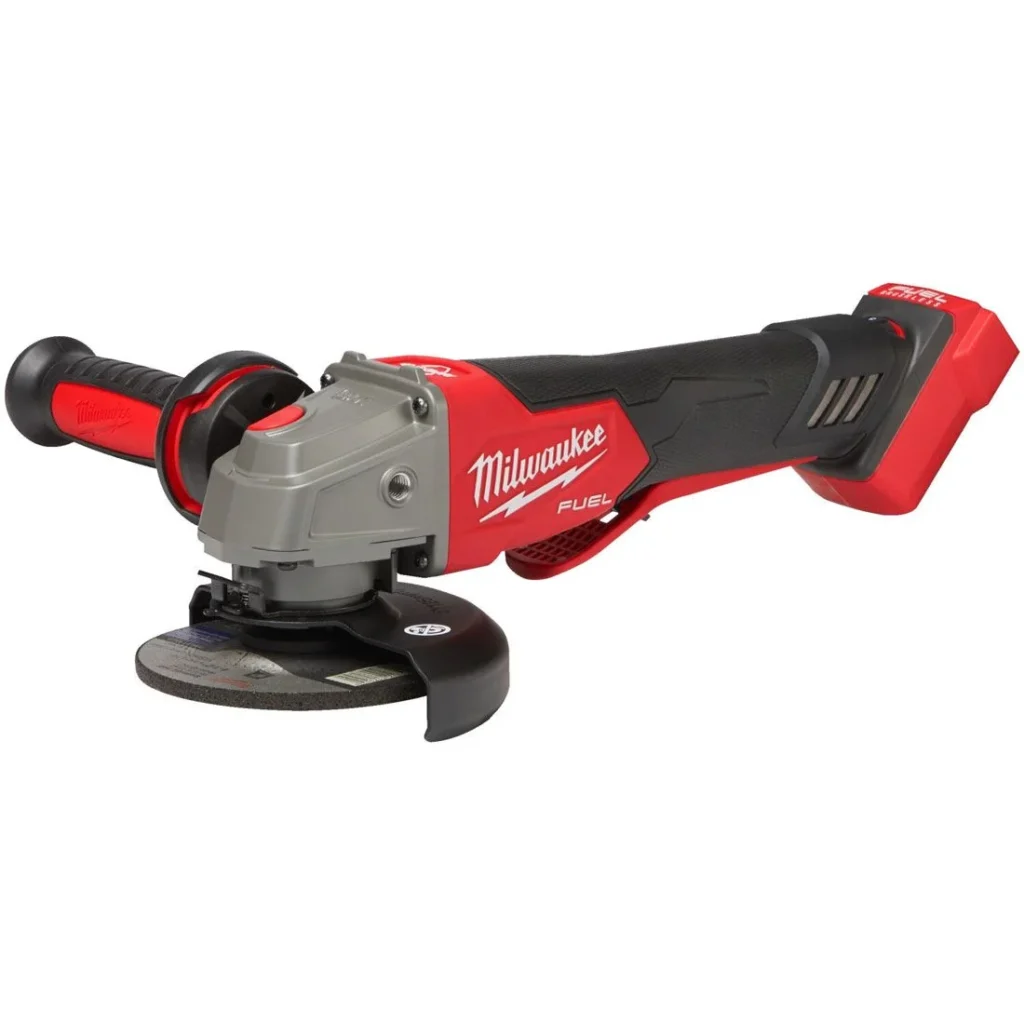
The Milwaukee M18FSAGV115XPDB-0 is a compact professional grinder built around a 115mm disc.
One of its most useful features is variable speed, allowing the user to adjust the grinder depending on the material and application.
It also combines a paddle switch with electronic braking and protection designed to react when the disc stalls.
For users already running Milwaukee M18 equipment, it also fits into the wider M18 battery system.
Key Features
- 115mm disc
- Variable speed up to 8,500 RPM
- Paddle switch
- Brushless motor
- Electronic brake
- Electronic clutch
- Tool-free guard adjustment
- Milwaukee M18 battery compatibility
What to Consider
- 115mm discs provide less cutting depth than 125mm or 230mm options
- It sits towards the higher end of the cordless grinder market
Suitable For
Fabricators, plumbers, engineers and general site trades needing a compact grinder for mixed cutting and grinding work.
Milwaukee M18FLAG230XPDB 230mm FUEL Grinder
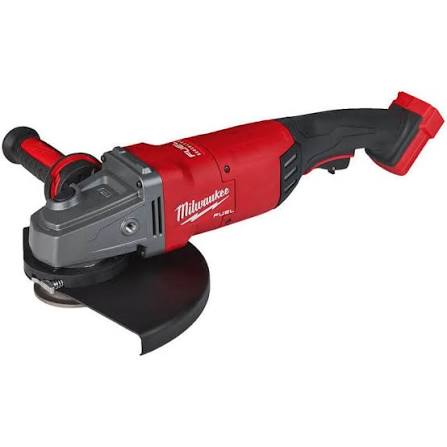
For substantially heavier work, Milwaukee also offers the M18FLAG230XPDB.
This uses a 230mm disc, giving it far greater cutting capacity than a standard compact grinder.
Its larger size makes it much better suited to jobs involving structural materials, heavy steel sections and larger masonry cuts.
Unlike smaller grinders that prioritise manoeuvrability, this model is intended for demanding cutting work.
It also uses Milwaukee’s M18 battery platform rather than requiring a separate cordless system.
Key Features
- 230mm disc
- Single-battery operation
- Paddle switch
- Electronic braking
- Brushless M18 FUEL system
- Large cutting capacity
What to Consider
- Considerably heavier than compact grinders
- Higher-capacity batteries are better suited to demanding work
- Unnecessary for most routine 115mm or 125mm applications
Suitable For
Structural steel work, civil construction, masonry cutting and other jobs where cutting depth matters more than compact dimensions.
DeWalt DCG405N 18V XR 125mm Grinder
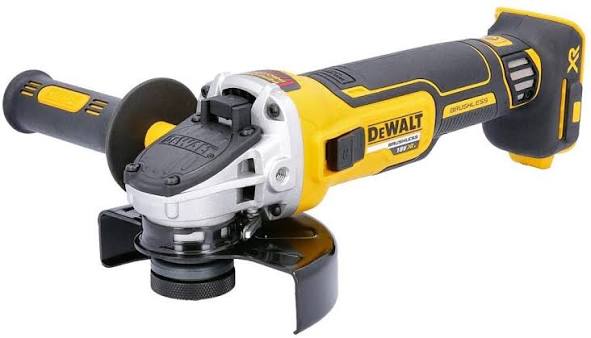
The DeWalt DCG405N is a popular option for users already invested in the 18V XR platform.
Its 125mm disc size provides a useful middle ground between compact handling and cutting capacity.
The grinder operates at up to 9,000 RPM and includes an electronic brake, electronic clutch and no-volt release system.
Its relatively slim body can also make it easier to handle when accessing pipework, steel sections or other restricted areas.
Key Features
- 125mm disc
- Up to 9,000 RPM
- Brushless motor
- Electronic clutch
- Electronic brake
- No-volt release system
- DeWalt 18V XR compatibility
What to Consider
- Uses a slide switch rather than a paddle switch
- Standard DCG405N models do not offer variable speed
Suitable For
DeWalt XR users who need a general-purpose cordless grinder for cutting, grinding and finishing.
Makita DGA517Z 18V LXT 125mm Grinder
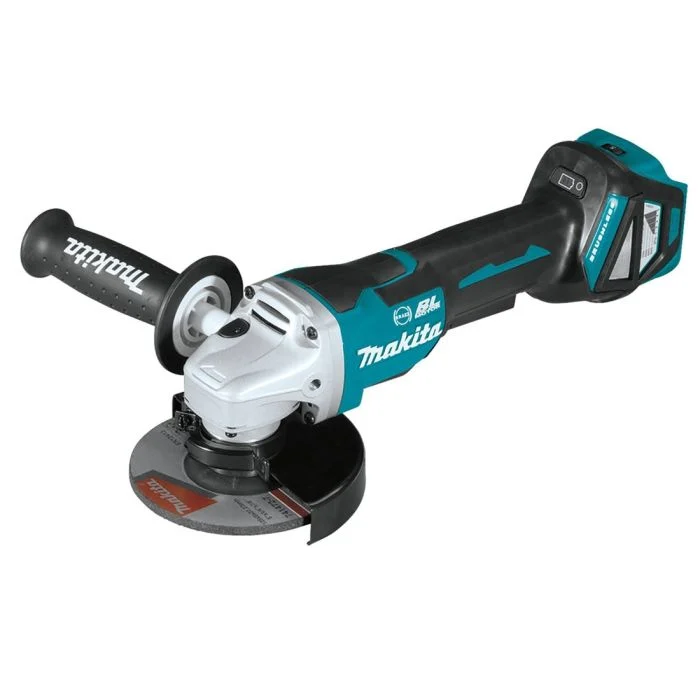
The Makita DGA517Z combines a 125mm disc with variable speed and a paddle switch.
It also includes Makita’s Active Feedback sensing Technology, commonly referred to as AFT.
The system monitors the tool during operation and is designed to shut power down if rotation suddenly falls because of a bind or stall.
Automatic Torque Drive Technology also adjusts the tool’s operating characteristics according to load.
Variable speed between 3,000 and 8,500 RPM gives the operator additional control when working across different materials.
Key Features
- 125mm disc
- Variable speed from 3,000 to 8,500 RPM
- Paddle switch
- Brushless motor
- AFT protection
- Automatic torque adjustment
- Soft start
- Makita 18V LXT compatibility
What to Consider
- More expensive than simpler LXT grinders
- Some users may not need variable speed for basic cutting and grinding
Suitable For
Makita LXT users carrying out regular fabrication, finishing and mixed-material work where greater speed control is useful.
Makita DGA504Z 18V LXT 125mm Grinder
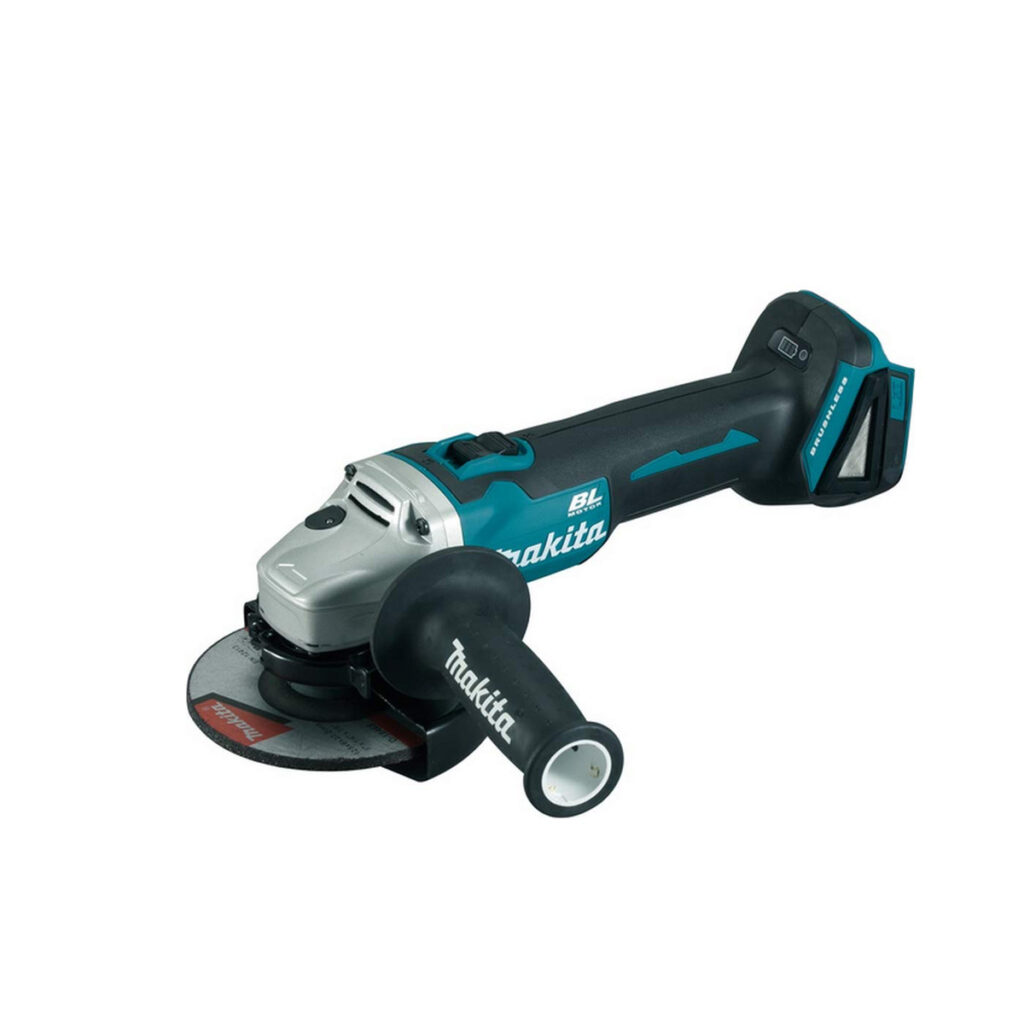
The DGA504Z provides a simpler alternative for Makita users who do not require all the features of the DGA517Z.
It still offers a brushless motor and automatic torque adjustment, but uses a slide switch and fixed maximum operating speed rather than the variable-speed arrangement found on the DGA517Z.
It also includes anti-restart protection and Makita’s XPT protection for harsher working conditions.
Key Features
- 125mm disc
- Up to 8,500 RPM
- Brushless motor
- Automatic torque adjustment
- Anti-restart protection
- Makita XPT protection
- LXT battery compatibility
What to Consider
- No variable speed
- Does not include the same AFT system as the DGA517Z
- Uses a slide switch
Suitable For
Makita LXT users who mainly need a grinder for everyday cutting, grinding and surface preparation.
Which Grinder Makes Sense for Your Trade?
The right choice depends heavily on the work you do.
For general cutting and grinding, a 125mm machine such as the DeWalt DCG405N or Makita DGA517Z provides a practical balance between cutting depth and handling.
For lighter work and restricted access, a 115mm grinder can be easier to manoeuvre.
If you regularly cut substantial steel sections, concrete or masonry, a 230mm grinder offers the depth required for jobs that smaller machines cannot comfortably handle.
Your existing batteries should also influence the decision.
If you already own several DeWalt XR, Milwaukee M18 or Makita LXT batteries, staying with the same platform can reduce the cost of adding another cordless tool.
Features Worth Paying For
For frequent professional use, look beyond maximum RPM.
Useful features include:
- Brushless motor
- Electronic braking
- Kickback protection
- Anti-restart protection
- Paddle or dead-man style switch
- Adjustable guard
- Variable speed where your work requires it
- Comfortable grip and manageable weight
You may not need every feature, but safety and control should take priority over minor differences in headline specifications.
Do You Need Variable Speed?
Not everyone does.
For straightforward cutting and grinding on common materials, a fixed-speed grinder may provide everything you need.
Variable speed becomes more useful when you regularly switch between materials or use accessories that perform better at different rotational speeds.
If your work includes more detailed metal finishing or varied fabrication tasks, the additional control may justify the higher price.
Cordless or Corded Angle Grinder?
Cordless grinders offer freedom of movement and are particularly useful where mains power is unavailable or cables would get in the way.
They also make sense for tradespeople who already carry several compatible batteries.
Corded grinders still have advantages for long periods of continuous use because there is no battery runtime to manage.
For workshop work, a corded grinder may remain perfectly practical.
For mobile site work, cordless models are often easier to use.
Selling Your Old Angle Grinder?
If you are upgrading your grinder, your old tool may still have value.
SellToolsOnline buys used power tools from customers across the UK, including angle grinders from DeWalt, Makita, Milwaukee, Bosch, HiKOKI and other professional brands.
We also buy drills, impact drivers, saws, breakers, nail guns and other trade equipment.
Send us clear photos, the model number, condition and details of any batteries, chargers, cases or accessories included.
Visit SellToolsOnline to send us your tools and request an offer.